DVLA Censors ban THOUSANDS of ‘76’ Number Plates
Screenshot
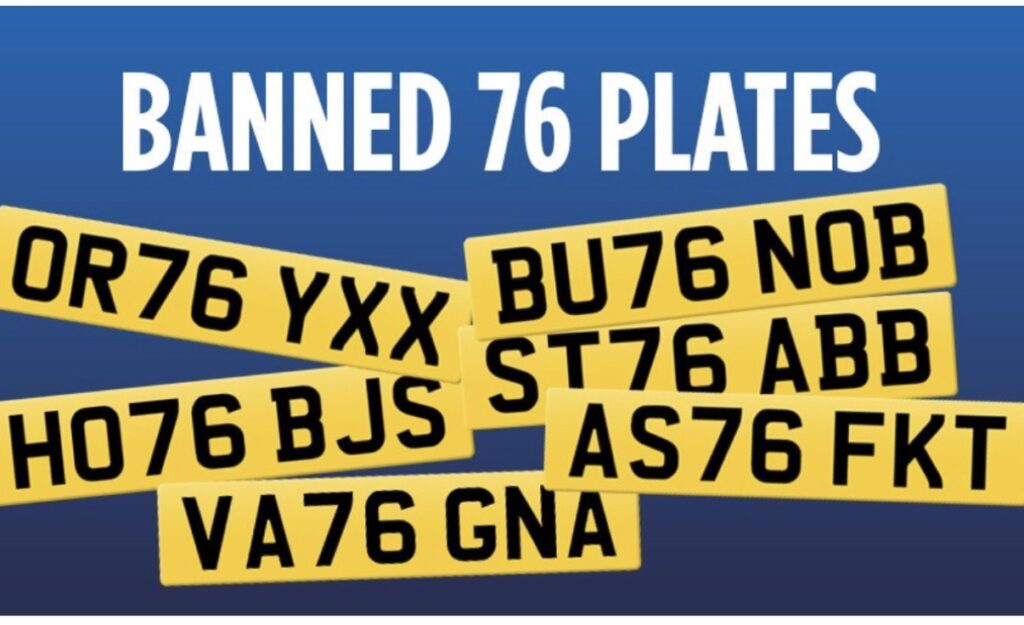
A Freedom of Information request has revealed the number of banned ‘76’ plates could reach more than one thousand combinations.
Each year, two new series of vehicle registration numbers are released for use on new cars – with the most recent being the ‘26’ plates, which began appearing on British roads earlier this month.
Mere days after their arrival, Regtransfers have now revealed the full list of banned combinations from the upcoming ‘76’ series. Due for release on 1st September 2026, a Freedom Of Information request to the DVLA made by the private plate provider has revealed the ‘76’ plates deemed potentially offensive or inappropriate for public use.
This is a longstanding practice for the DVLA; since the earliest days of British vehicle registration numbers, the government has made efforts to suppress any potentially upsetting text that may appear on number plates.
Initially, even mild references fell foul of the censors’ scrutiny. For instance, the letter pair ‘BF’ was banned for some time, in case someone interpreted it as standing for “bloody fool”. The bar has been raised somewhat since then, and the banned plates of today are typically a little more obscene in nature.
Generally, the DVLA blocks registration numbers that could be interpreted as conveying obscenity, insults, racism, sexism, LGBTQ+phobia and other hateful or bigoted messages. The bans also extend to terms relating to religion, war, weapons, criminality, violence, drugs, sex, certain body parts and bodily functions.
The full list of banned ’76’ registration numbers clocks in at 513 specific registration numbers, with 10 “wildcard” combinations. These wildcard plates are presented as combinations with asterisks in positions that would, in reality, be occupied by letters. The asterisk is a placeholder that stands for any character; regardless of which letter would appear in the marked position, the resulting registration number is banned. Some examples of these wildcard combinations include ***W76 NKS, *T76 NNY, *F76 GOT and *N76 ERR. Typically speaking, it’s these wildcard combinations that could see thousands of potential plates banned from British roads.
When it comes to specific banned plates, combinations such as BJ76 HOT, OR76 YXX, OR76 YYS and OR76 YYX appear in the list, most likely due to the perceived references of sexual activities. BU76 GAY and CU76 LEZ are fairly clear references to sexual orientation, while CU76 JAP and GE76 PAK have been blocked due to their proximity to racial slurs.
Concerning modern political sensitivities, GU76 JEU and GU76 JUW have also been banned, likely due to their potential to be displayed in an antisemitic context. Equally, AU76 WTZ has been blocked from release, likely seen as a reference to the WWII Nazi concentration camp at Auschwitz in occupied Poland.
Commenting on the latest wave of banned plates, Regtransfers CEO Mark Trimbee states:
“Each time a new registration series is introduced, the DVLA has to anticipate how thousands of possible combinations might be interpreted once they reach the roads. While most plate combinations are completely harmless, there will always be a number that could be read in ways that people might find offensive or inappropriate.
“The DVLA takes a cautious approach, and they’re right to do so, but it’s interesting to note that the total number of banned plates from each individual release seems to be creeping upward. While it’s important to protect the British public – and many of the DVLA’s decisions are justifiable – one has to wonder where the line between offence and a bit of ‘cheeky’ fun can be drawn. AR76 RSE, for example, has most likely been banned due to its likeness to a word relating to a body part – however it’s a word that I imagine exists in the vocabulary of most Brits as being fairly inoffensive in general.
“Overall, however, the full list of banned plates contains a number of plates that most definitely don’t belong in circulation, due to their potential to cause genuine offence. That’s the primary purpose of these bans, and it’s good to see the DVLA working to protect the British public from harm.”